Social Media Isn't One-Size-Fits-All: Building Strategies That Actually Work for Your Business

You've probably seen them, those templated social media strategies promising to work for "any business." Post three times a day, use these trending hashtags, follow this content calendar, and watch your engagement soar. Sound familiar?
Here's the reality: if you're treating social media like a one-size-fits-all solution, you're essentially trying to play a symphony with a kazoo. Sure, you're making noise, but you're not creating the kind of resonance that actually moves people to action.
After two decades in the social media space, I've watched countless businesses fail not because they weren't posting enough, but because they were following strategies designed for someone else's audience, goals, and voice.
The Fatal Flaws of Cookie-Cutter Social Media
Generic social media strategies fail for three fundamental reasons, and understanding these will save you months of spinning your wheels.
First, they ignore your unique audience frequency. A B2B software company trying to replicate a fashion retailer's Instagram strategy is like a classical violinist trying to play death metal: technically possible, but completely missing the mark. Your audience has specific pain points, communication preferences, and decision-making processes that generic templates simply can't address.
Second, they prioritize activity over strategy. Most templated approaches focus on posting frequency and trending content rather than meaningful engagement with your specific market. You end up busy but not effective, posting content that generates likes from people who will never buy from you.
Third, they can't adapt to your business model. A local service business needs a completely different approach than an e-commerce store or a SaaS company. Yet most generic strategies treat all businesses as if they have identical sales cycles, customer acquisition costs, and conversion pathways.
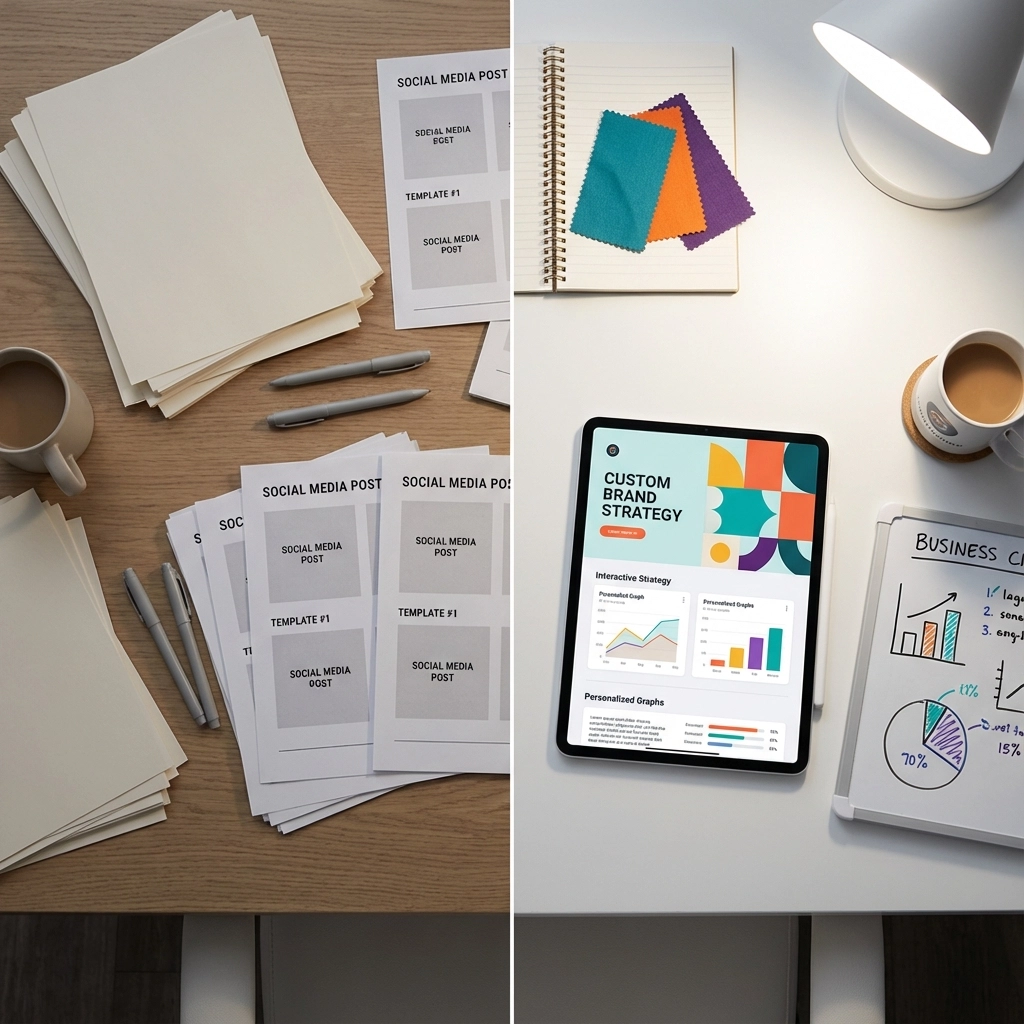
How We Tune Your Strategy to Your Business Frequency
At Superior Data Solutions, we don't believe in loud marketing: we believe in resonant marketing. Our approach starts with understanding that your business has its own unique frequency, and our job is to help you find and amplify it.
Step 1: Deep Listening (The Discovery Phase)
Before we create a single post, we spend 2-3 weeks in what we call "discovery mode." We're not just looking at your current social media: we're analyzing your entire business ecosystem.
For a recent client in the professional services space, this meant understanding that their ideal customers were executives who consumed content differently on LinkedIn versus other platforms. They needed thought leadership content during business hours and industry insights, not the lifestyle content that worked for their B2C competitors.
Compare that to our work with a local fitness studio, where we discovered their audience was most active on Instagram during early morning and evening workout windows, and responded best to motivational content mixed with real transformation stories from current members.
Same social media platforms, completely different strategies: because we listened first.
Step 2: Strategic Planning (The Architecture Phase)
Once we understand your unique business frequency, we architect a strategy around three core pillars: your audience's communication preferences, your business goals, and your authentic brand voice.
This isn't about choosing between Facebook or Instagram: it's about understanding that your accounting firm's LinkedIn strategy should focus on building trust through expertise, while your restaurant's Instagram should showcase the experience and community you create.
We map your customer journey and identify exactly where social media fits in your sales process. For some businesses, social media is the first touchpoint. For others, it's where existing customers become advocates. These different roles require fundamentally different approaches.
Step 3: Precision Execution (The Performance Phase)
Here's where boutique agencies truly differentiate themselves: we execute with the precision of a master musician, not the volume of a garage band.
Every piece of content serves a specific purpose in your overall strategy. Every post timing is based on when your specific audience is most engaged. Every interaction is handled with your brand voice, not a generic template response.

Real Customization in Action
Let me show you what true customization looks like with three different clients we've worked with recently:
Manufacturing Company (B2B Focus): Their audience of procurement managers and facility directors wasn't on TikTok: they were on LinkedIn during specific times of day, looking for industry insights and vendor credibility. We focused on educational content showcasing their expertise, behind-the-scenes facility tours, and customer success stories that demonstrated real ROI. Result: 340% increase in qualified leads over six months.
Local Restaurant Group: Their success depended on emotional connection and community building. We developed a strategy around showcasing their food preparation process, highlighting local suppliers, and creating user-generated content campaigns that turned customers into brand advocates. Each location had slightly different content approaches based on their neighborhood demographics.
Professional Services Firm: They needed to build thought leadership with C-suite executives: people who don't have time for lengthy content but need to see expertise. We created a content strategy around industry insights, quick-hit educational posts, and strategic engagement with their prospects' content. The key wasn't posting more; it was posting smarter.
Why Boutique Agencies Deliver Better Results
Large agencies and automated solutions promise scale, but they deliver the social media equivalent of elevator music: technically competent but forgettable. Here's why boutique agencies like Superior Data Solutions consistently outperform:
We know your business by name, not account number. When your industry faces a challenge or opportunity, we're already thinking about how it affects your specific strategy. We're not managing 200 accounts with templated responses: we're partnering with a select number of businesses where we can deliver transformative results.
We adapt in real-time. When the algorithm changes or your business priorities shift, we pivot immediately. Large agencies need committee meetings and approval chains. We make strategic adjustments because we understand your business goals at a deeper level.
We measure what matters to your bottom line. While others focus on vanity metrics like follower count, we track metrics that correlate with your actual business success: qualified leads, customer acquisition cost, lifetime value, and conversion rates.

Building Your Own Resonant Strategy
If you're currently using a generic approach, here's how to start developing a strategy that actually fits your business:
Start with business goals, not social media goals. What does success look like for your company in the next 12 months? How can social media contribute to those specific outcomes? Your social strategy should be a subset of your business strategy, not a separate entity.
Define your unique value proposition clearly. What makes your business different from competitors? This difference should be evident in every piece of content you create. If your social media could belong to any business in your industry, you're not being specific enough.
Choose platforms based on where your customers actually spend time, not where you think they should be. This requires actual research, not assumptions. Where are your current best customers discovering new solutions? Where do they go for industry information?
Develop content themes that reflect your expertise. Instead of random posting, create 3-5 content pillars that demonstrate your knowledge and help your audience solve problems. These should align with what you want to be known for in your market.
Test and iterate based on your specific audience response. What works for other businesses in your industry might not work for you. Track engagement and conversion metrics specific to your goals, and adjust accordingly.
The Bottom Line
Social media isn't about being everywhere or posting constantly: it's about being strategically present where your audience needs you most. It's about finding your unique frequency in the digital space and amplifying it consistently.
The businesses that succeed on social media aren't necessarily the loudest or most frequent posters. They're the ones who understand their audience deeply, communicate authentically, and deliver consistent value that aligns with their business goals.
If you're ready to move beyond generic templates and build a social media strategy that actually works for your specific business, let's start with a conversation about your goals. We'll help you find your frequency and amplify it in ways that deliver real, measurable results for your bottom line.
Because at the end of the day, the goal isn't to sound like everyone else( it's to sound unmistakably like you.)
Comments